

Home
General considerations
A data management plan (DMP) shows that you have thought about how to create, store, archive, and give access to your data during and after your research project.
Taking the role of a data steward, you should always be able to describe the complete operational workflow for your research data, from data capture, to data analysis, archiving, and sharing. A DMP helps you to think this through. You are responsible for answering questions about the origin of your data, data manipulations, the location where the data are analysed and archived, and with whom they are shared under what conditions.
If your research data contain personal data, it is essential to ensure that the privacy of the persons involved is protected during all phases of your research. When you share or link data with a third party, you need to take additional measures.
Data Management Support
Your UMC should provide a standard workflow description for researchers, a general data management infrastructure that is compliant with current regulations and guidelines, and DMP templates. We therefore advise you to contact experts at your UMC to help you with these issues; you can use the toolbox to locate experts and find resources.
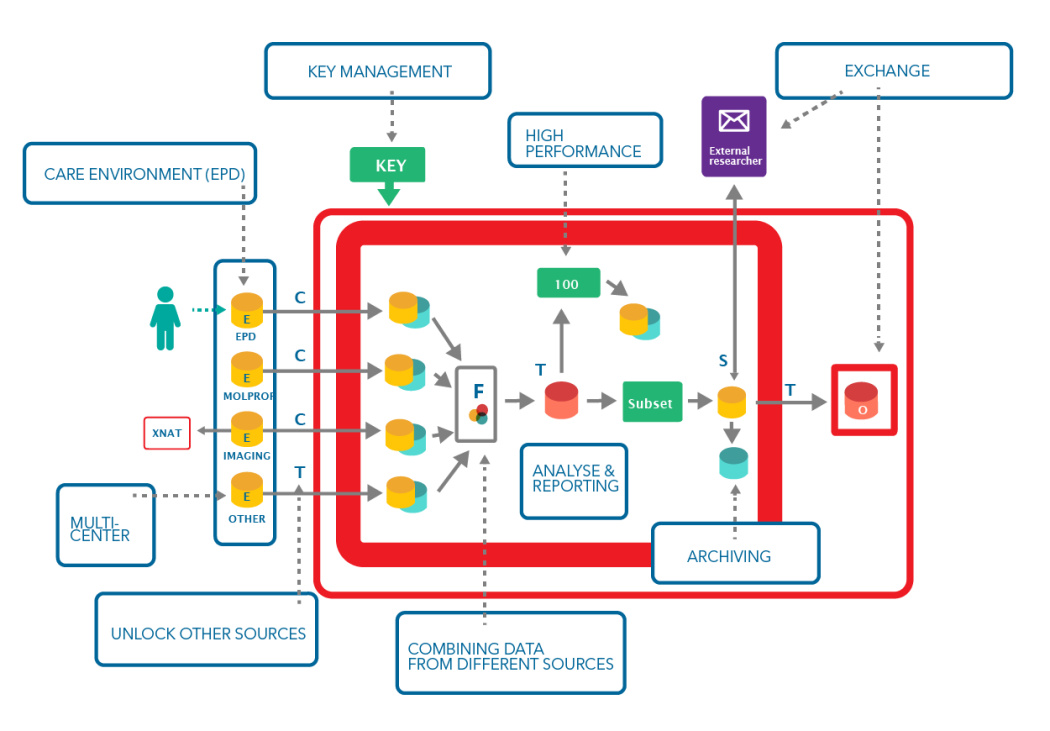
Figure: Example of an ‘operational workflow chart’. In your data management plan, you describe all the relevant steps and functionalities that are shown in the chart. This may help to create an overview. This example shows the typical activities around clinical data, including repositories.
-
What do research funders expect?
Funding bodies require varying degrees of data management planning at the grant proposal stage and after grant awarding. Many research funders request that you:
- create and follow a data management plan;
- create FAIR data;
- share some or all of your data with the public;
- share some or all of your data for further research or verification of your research results.
-
Why should I consult an expert about data acquisition techniques?
You can use a variety of techniques to generate data. Familiarity with one technique does not necessarily make that technique the best for your particular study. You should consult experts to make sure you make a good choice.
-
Why should I consult an expert about the sample size?
Careful study design is required to ensure that your research question can be answered in the end. For instance, you should select the most appropriate technique and determine the sample size required to get statistically meaningful results. Scientific reviewers and ethical committees tend to carefully look at this aspect, especially when patients or animals are involved. Study design is the domain of specialists, who can be consulted in the design phase of the study. In addition, you can follow basic courses on study design, good clinical practice, and research data management.
-
When should I make a statistical analysis plan?
A statistical analysis plan is mandatory for randomised controlled trials and it is advisable in the majority of other studies. You should create the statistical analysis plan prior to analysing your data, but it is preferable to create it even before you start collecting data. This is because it facilitates proper study design (e.g., inclusion and exclusion criteria, number of study subjects needed, decisions with regard to statistical power, choice of data items to be collected) We recommend having the plan validated by a statistician.
-
Further reading
- Mantra course;
- ZonMW: DATA: Digitale diamanten;
- ZonMW: Data management plan;
- DANS: Data management plan for scientific research;
- KNAW: Open access and digital preservation;
- Checklists data management:
- UK data service: checklist and costing tool;
- DCC checklist;
- DataverseNL.