

Home
International data and sample sharing. What can we learn from these international data-sharing projects?
During the Health RI 2022 conference, one of the afternoon session had as its topic “international data and sample sharing - in the Netherlands, Europe, and beyond". The session was moderated by Egge van der Poel, data scientist and advocate of large-scale data sharing. Six guest speakers presented international data-sharing projects they are involved in, the obstacles they encounter, as well as their solutions.
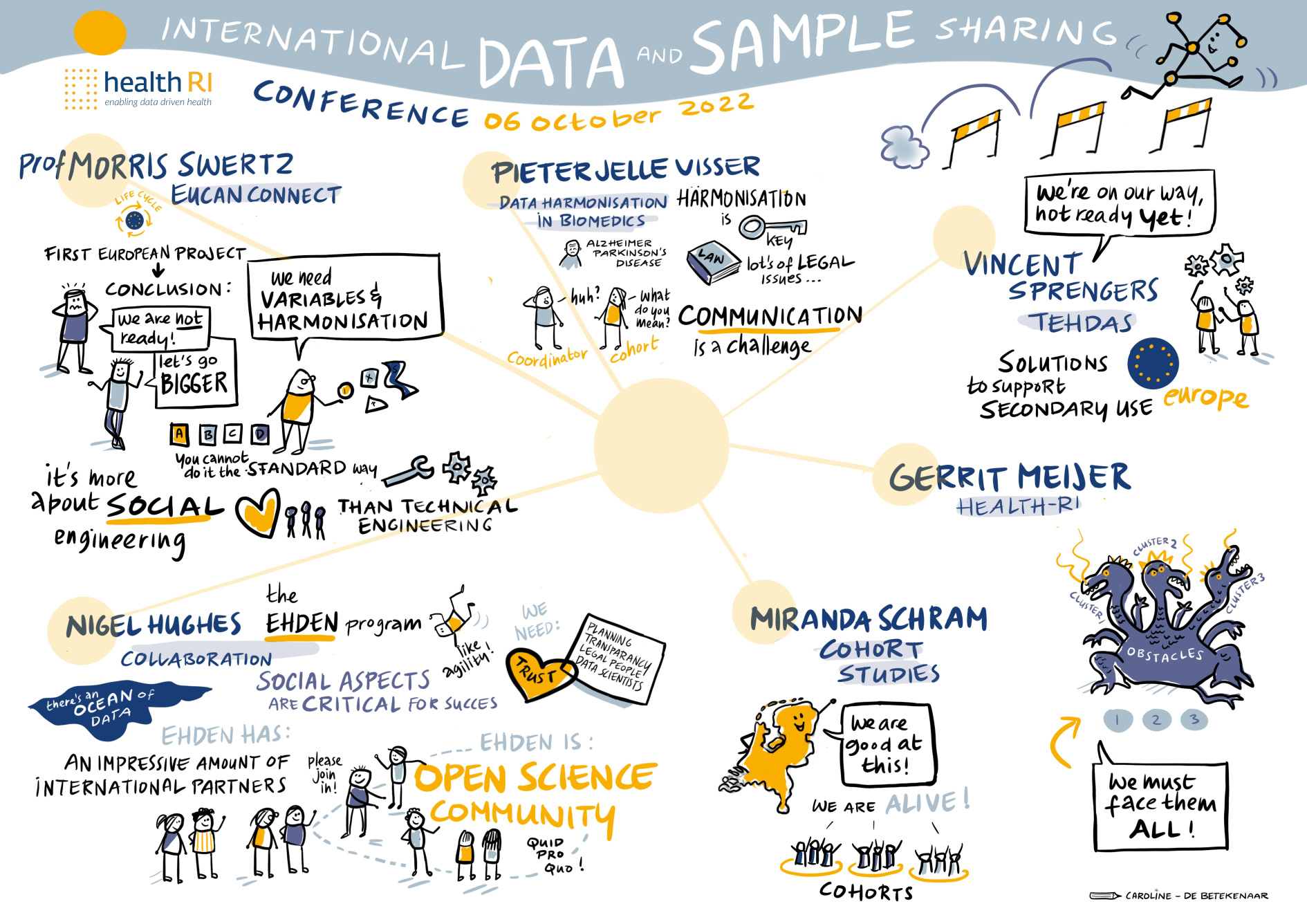
The first speaker, Morris Swertz, professor of bioinformatics at UMC Groningen, talked about the EUCAN-Connect project, a European-Canadian data infrastructure-in-development. The name EUCAN is not only a contraction of the participating countries, but when pronounced "you can connect", it also sounds optimistic and positive.
EUCAN aims to unlock health data for research on a large scale, across participating countries. This is to be done by harmonizing and cataloging data from already existing databases. The privacy of citizens will be safeguarded by a method called ‘DataSHIELD’. EUCAN's approach is based on a federated architecture: all participating parties and data suppliers are independently responsible for unlocking their data, in accordance with guidelines and standards. No central database will be set up. This enables breaking down research questions into small partial analyses, which then take place within each of the participating institutions.
High ambitions
EUCAN’s ambitions are high and many obstacles had to be overcome, none of them technical. First, there are major differences in regulations between the participating countries. Secondly, trust had to be gained that the analyses sent are safe. Finally, sufficient manpower had to be organized timely within each institute to enable implementation of new extensions to the DataSHIELD network. In addition, EUCAN wants to design a public-friendly user interface. "EUCAN shows that it is possible to bring all data together in one project.” Swertz says. "It is a network of networks. New and smaller-scale projects can join EUCAN to share data, instead of reinventing their own wheel and thus maintaining fragmentation."
Then Pieter Jelle Visser, professor of molecular epidemiology at UMC Maastricht, presented several European projects, which collect not only data from Alzheimer's patients but also patient samples (particularly blood and spinal fluid). The problems he encounters are similar to Swertz's: too many parties try to find their own solutions for data harmonization and there is a lot of miscommunication. In addition, there is a shortage of legal specialists in hospitals when it comes to control procedures and data sharing projects. The legal part of the work is expensive and time-consuming but indispensable. A national regulatory framework for patient’s control over their data would be preferred over individual solutions for each separate project.
Visser also showcased a recently started European project in the field of Alzheimer's and Parkinson's disease (EPND), which focuses on establishing a joint data platform for which data harmonization is a time-consuming prerequisite. Right from the start this project pays close attention to the future sustainability of the soon-to-be-developed data platform, to case studies and to the involvement of patients and other stakeholders.
The problem of the difficult exchange of data and patient material does not lie with the individual projects’ partners: there is a great hunger for collaboration, according to Visser. However, the willingness to cooperate and share data and knowledge is met with technical difficulties: each subfield has its specific approach, making data harmonization time-consuming. It is also important that research cohorts be funded more sustainably.
European Health Data Evidence Network
Nigel Hughes, scientific director for patient data at Janssen Belgium, is also familiar with the problem of specialist staff shortage. Hughes is one of the driving forces behind a major European project, the European Health Data Evidence Network (EHDEN). This project currently builds an infrastructure, based on the large-scale standardization of existing data. EHDEN also handles data analysis with a federated approach, using a strictly defined data model called OMOP, which is already used across the globe.
Hughes indicates that EHDEN takes place in project form now but is designed to remain viable beyond its defined end date. His advice to starting consortia is to be transparent, define a clear goal, implement good project management and be patient with the people you work with. "We already have good examples of public-private partnerships and there is already a lot of knowledge. Don't reinvent the wheel. Learn from the past, improve the present, make the future easier."
An (inter)national approach is needed
Moderator Egge van der Poel then turned to the conference participants, using a poll to hear about the obstacles that they face in their own work. These are very similar to those of the speakers: too little input and manpower from legal, ethical and social perspectives, lack of structure and trust, and a need for funding. Not a surprising picture, given that each party keeps looking for its own solutions. An (inter)national approach is needed.
Vincent Sprengers, researcher at RIVM, then spoke about the Towards European Health Data Space project (TEHDAS), which should serve as an advisory body for the future EHDS (European Health Data Space) by developing data-sharing concepts. EHDS is a new European regulation for large-scale health data sharing, both for healthcare across European borders and for research and innovation. In co-operation with the Swedish government, RIVM has a leading role within TEHDAS around the theme data sharing. However, there are no concrete solutions yet. Sprengers especially emphasized the importance of development and implementation of current ideas. In this process, the European Union's broad definition of the European Health Data Space still leaves much room for the exchange of ideas between TEHDAS and EHDS.
Tackling the obstacles for the re-use of health data
Gerrit Meijer, Chief Science Officer of Health-RI, then explained the Obstacle Removal Trajectory, the national integral framework created by the ministries of VWS, OCW, EZK and Health-RI, in collaboration with all stakeholders. This framework can be found on the Health-RI website and lists all the obstacles for the re-use of health data for research. Meijer's advice is unequivocal: the obstacles form a multi-headed monster that must be dealt with as an entity. "We can't solve bits and pieces like pet projects and then think we're there," he explained, "it's all or nothing. We have to seize and hold on until everything is settled at national level." A major obstacle he mentioned is the variety of interpretations and implementations of the General Data Protection Regulation (GDPR). This variety creates a lot of ambiguity, differences in interpretation and different procedures, both within the Netherlands as well as between countries.
30 years of experience
Finally, Miranda Schram, associate professor at UMC Maastricht, presented the work of the Netherlands Cohort Consortium (NCC). The NCC conducts population research on diseases and factors such as lifestyle and environmental aspects. This is done through 11 nationwide distributed cohorts, in which citizens are monitored for long periods of time. Thanks to 30 years of experience, NCC has reached high levels of quality but needs further scaling. Schram expressed the ambition to raise the number of research participants from 440,000 to 1 million. Another aim is to harmonize old and new data: not after data collection but at the beginning of it. Like Swertz and Hughes before her, Schram assumes a federated structure, high data accessibility and a privacy assuring organization such as EUCAN. Structural funding for NCC and closer collaboration between cohorts are essential to realize these ambitions.
After the presentations, the speakers answered questions from conference participants. When asked how the plans and ideas will be implemented, the answer was that this conference is a good opportunity to stimulate co-operation and defragmentation. Fewer separate trajectories are needed instead of more, but they must be initiated in co-operation and integrally at (inter)national level. In the words of Gerrit Meijer: "That's why we have Health-RI".
Finally, Nigel Hughes emphasized that the work already underway still seems to be too invisible. Anyone reading legislative texts on the EHDS would get the impression that nothing at all exists in this area yet, but the opposite is true: a lot of work has already been done to create safe, international data-sharing projects. From this work, the generic and scalable elements need to be extracted to implement them at (inter)national level.