

Expertise
Supporting research, policy, and innovation
Researchers, policymakers, and innovators (collectively also referred to as data users) need access to health data to develop new insights and enable better healthcare.
Health-RI is working on a national health data infrastructure that makes finding, requesting, and securely reusing health data for research, policy, and innovation easier. This gives data users faster insight into:
- which datasets are available
- where this data is located
- and under which conditions it can be used
This makes it easier to conduct research aimed at, for example, new treatments, prevention, or improvements in healthcare.
How does data reuse work within the national infrastructure?
To support data users, Health-RI is developing a national infrastructure for finding, requesting, and securely analysing health data. At Health-RI, we work on the entire process surrounding the reuse of data. We call this process the data journey. This data journey consists of the following steps:
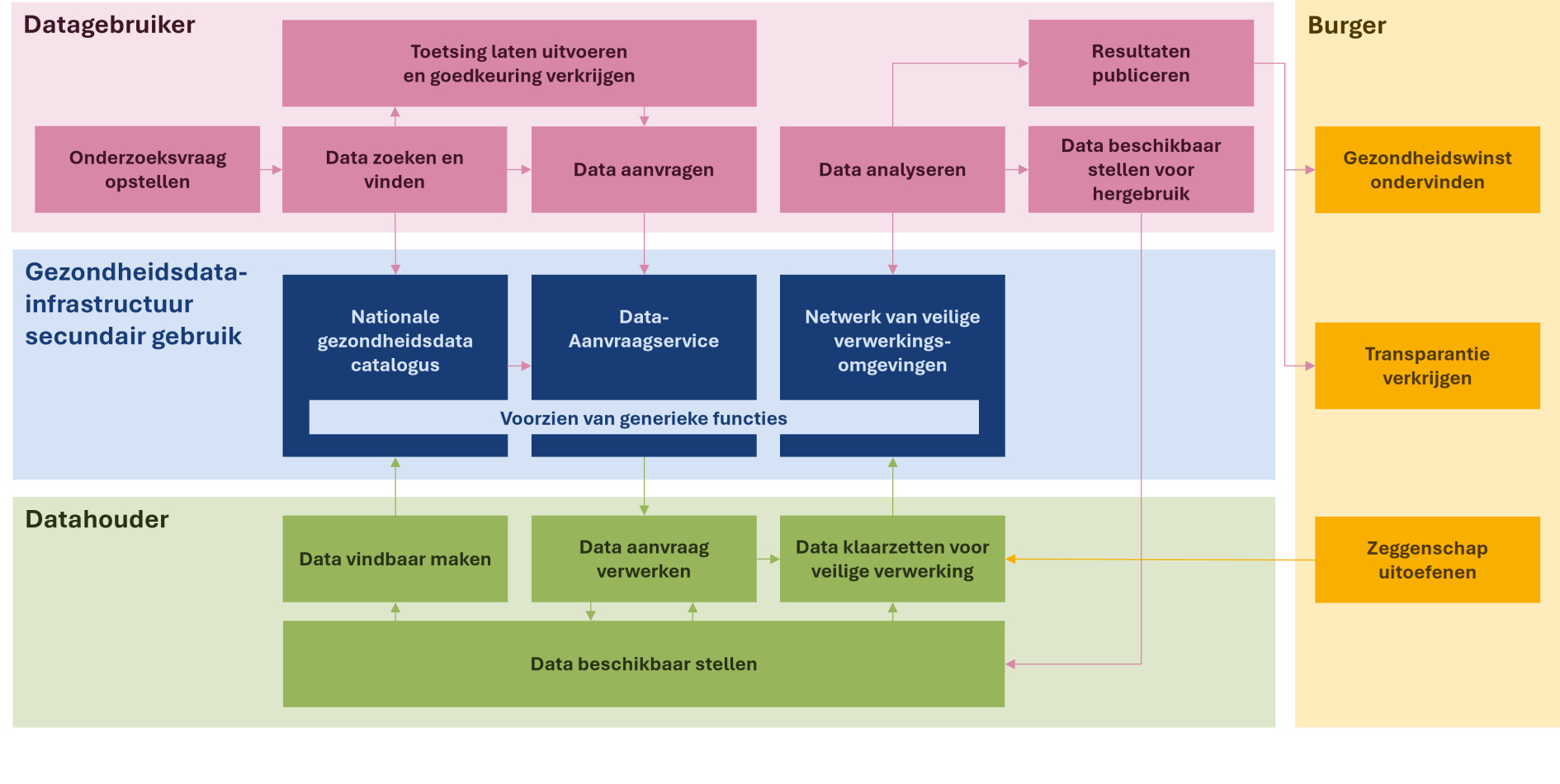
The steps in the data journey for secondary use
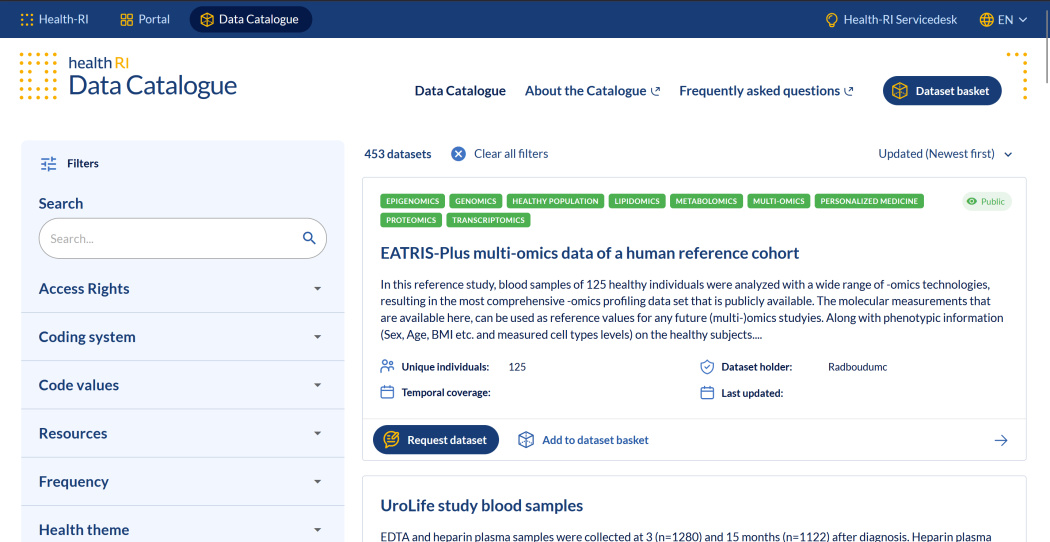 The National Health Data Catalogue
Finding and sharing data in the National Health Data Catalogue
Health-RI is currently developing the National Health Data Catalogue. In this catalogue, data holders, such as hospitals, general practitioner practices, and other organisations, can make metadata about their datasets available, so that these datasets can be found for reuse by data users, such as researchers, policymakers, and innovators. Data users can search and filter datasets in the catalogue to find the right datasets for their research. Take a look at the website of the National Health Data Catalogue. We regularly expand both the functionalities and the number of datasets.
Requesting data through the Data Request Service
Heb je de datasets gevonden die je nodig hebt?
Have you found the datasets you need? Through the Data Request Service, you will soon be able to request multiple datasets from different data holders with a single request.
This streamlines the currently complex process in which each organisation uses different application methods and assessment criteria. The request service collects all the necessary information to carefully assess your research application. Take a look at the Data Request Service and let us know how we can further improve it.
Requesting datasets from the catalogue for research, policy, and innovation is already possible, and we continuously work on improving the request process.
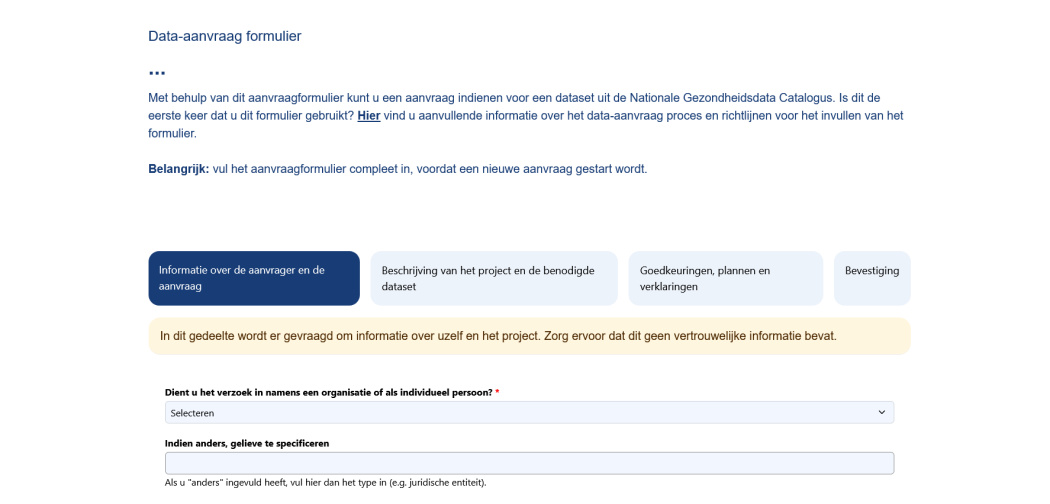 The data request service
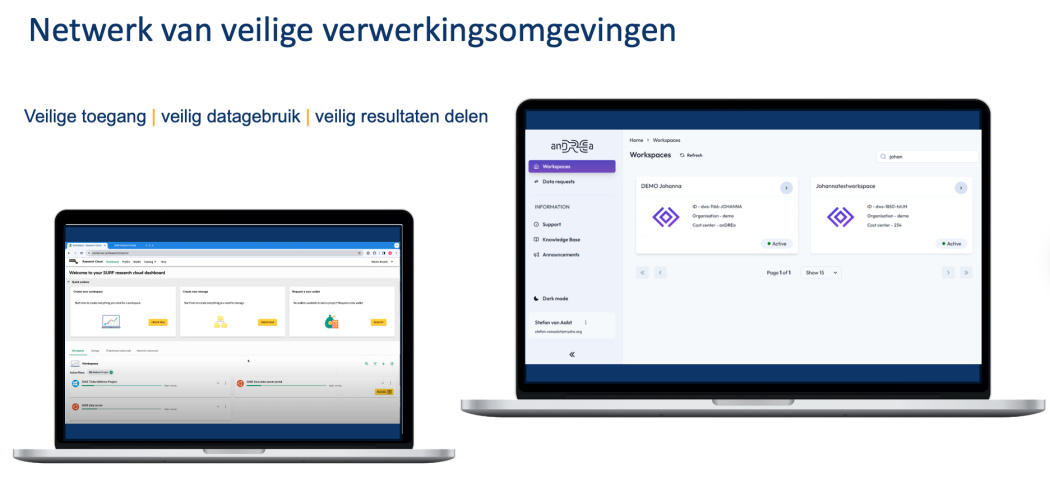
Reusing data in a network of secure processing environments
Has your request been approved? Then the data holders will start preparing the requested datasets in a secure processing environment. This involves linking, pseudonymising, or anonymising datasets, so that they can be used safely and collectively.
Careful handling of sensitive health data is essential. Therefore, datasets are always made available in secure processing environments within the national health data infrastructure. Only the people approved in the request will receive access. For these secure environments, Health-RI collaborates with various partners.
After access is granted, the data user can start the research. The results of this research will hopefully contribute to health benefits for society. Once the research has been completed, the generated research data will also be made available for reuse through the data catalogue, allowing new studies to build upon them. The network of secure processing environments is still under development.
You can find more information about secure processing environments here!
What will change with the arrival of the European Health Data Space (EHDS) regulation
The European Health Data Space (EHDS) strengthens patient rights and promotes scientific research, innovation, and policy. The EHDS sets out rules to make it easier to share health data, for example with healthcare providers, other European countries, researchers, and policymakers.
With the arrival of the European Health Data Space (EHDS), many things will change for data users. Reusing health data for research, policy, and innovation will become a right, and sharing data will become an obligation.
For data users, this means that the reuse of health data will have a clearer legal framework and will be better organised through national and European data infrastructures. By 26 March 2029, the EHDS must largely be implemented. Health-RI is currently working through the HDAB-NL project to prepare for the implementation of the EHDS.
What does this mean in practice for data users?
As a data user, in the future you will be able to:
- submit a request when there is a valid reason to use health data for secondary use
- pay a fee for the use of data, part of which will go to the data holder
- comply with the conditions of the data permit
- gain access to data that is anonymised or, if this is not possible, pseudonymised
- work with this data in a secure processing environment
- publish research results and outputs so that they can be found through the Health Data Access Body (HDAB)
Services for data users
Through the National Health Data Portal, Health-RI provides support to both data users and data holders.
On the portal, users can:
- find explanations about the National Health Data Catalogue
- ask questions about requesting datasets
- receive support in preparing data requests
In addition, the portal offers training and guidance, including through the Health-RI Academy. These trainings focus, for example, on:
- data availability and data quality
- aiming to make data FAIR (Findable, Accessible, Interoperable and Reusable)
- data stewardship
Through the portal, users also gain access to various tools and infrastructures, such as:
- other data catalogues (for example the BBMRI catalogue and cBioPortal)
- tools for medical imaging data such as XNAT
- secure processing environments such as SURF SANE
ELSI servicedesk
The reuse of health data often raises ethical, legal, and societal questions. The ELSI servicedesk supports researchers, professionals, ethicists, legal experts, policy advisors, and patient representatives with questions related to: ethical aspects legal frameworks societal implications of data use The helpdesk provides information and advice to enable responsible use of health data.