Expertise
ELSI
With ELSI, we mean the framework of Ethical, Legal and Societal Implications that need to be considered when building a national health data infrastructure and working towards a learning healthcare system to be able to (re)use health data optimally and to the maximum extent. For research, innovation, evaluation and quality management, it is essential that these implications are handled in a nationally aligned and standardized manner. Reaching national alignment, translate national standards into practice and offer service and support are the main tasks of the ELSI team.
Three core activities
ELSI Strategy: Work towards national alignment, harmonization and standardization about current and future ethical, legal and societal aspects, resulting in national standards and trust frameworks. Here we focus on national coordination and standardization of the most urgent ELSI topics, such as the legal basis for the (re)use of the data, ensuring control and privacy, and being able to connect data safely and reliably.
This will be mainly done through the Obstacle Removal Trajectory. International developments, such as the European Health Data Space (EHDS), will also be monitored under this Key Activity.
ELSI compliance-by-design: Simply aligning and standardizing procedures may not be enough for all organizations to comply easily. To ensure compliance, it is essential to integrate these standards into existing or future digital systems and infrastructure. By doing this, complying with the standards becomes almost effortless and is already built into the system. This is what we call compliance-by-design.
ELSI Support: Spreading the word about existing and new ELSI standards. This means we communicate, give advice, provide training, support, and share knowledge to make it easier for people to understand and use the standards.
This activity is mainly carried out via the ELSI Service Desk.
Our projects
-
Obstacle Removal Trajectory
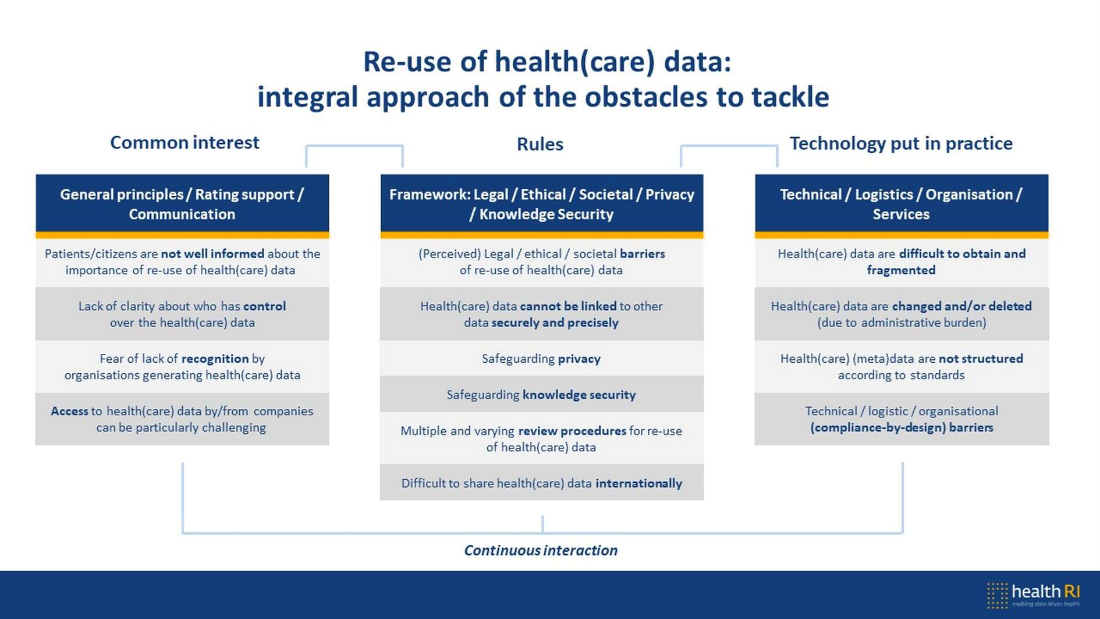
For a learning healthcare system, it is crucial that health data (including bodily material), can be used for research & innovation, healthcare evaluation and quality management. Data from the same person is generated in different locations and at different times. Therefore, for optimal use, it is also necessary that data on illness and health can be linked at an individual level. Currently, the use and linking of data is limited by several obstacles. The obstacles can be categorized into three clusters, of which Cluster 2 "Rules" deals with the ethical, legal, and societal implications.
We have formulated eight solutions that effectively address all obstacles. If you wish to actively participate in implementing these solutions, please get in contact with us.
More information about the Obstacle Removal Trajectory can be found here.
ELSI Servicedesk
The ELSI Servicedesk offers guidance on and answers to the ethical, legal and societal questions around (re)using health data and samples in health research faced by life science professionals, policymakers, ethicists and legal experts. The website provides frequently asked questions with answers, and the opportunity to contact the helpdesk, where ELSI experts answer questions.
The ELSI Servicedesk can be found here.
Implementation of the Code of Conduct
With the revised Code of Conduct, the field of health research takes an important step towards better, responsible handling of body material and health data in health research. Implementation of the Code of Conduct is now underway in collaboration with:
- Committee on Research Regulation (COREON)
- Health-RI
- Netherlands Federation of University Medical Centers (NFU)
- Association of Collaborating Top Clinical Hospitals (STZ)
- Federation of Medical Specialists (FMS)
- Dutch Association for Pathology (NVVP)
The Code of Conduct can be found at coreon.org. More information about the project can be found here.
Metadata standard for the conditions of data use
Metadata are 'data about data', or information needed to interpret, understand and use the dataset. Metadata in the field of ELSI concerns the conditions under which data may be used, for example:
- For which disease states may the data be used?
- May it be used for commercial research?
- Should side findings be fed back?
- May it be linked to other data at the individual level?
- Is ethical review required and if so, by whom?
More information about metadata can be found here.
Data governance for COVID-NL
One of the projects in the Dutch COVID-19 Data Support Program is COVID-NL, a registration of UMC intensive care data of COVID patients. The data governance is coordinated by the ELSI team. Current activities focus on the design and improvement of the review process for the release of data.
More information about the COVID-19 Data Support Program can be found here.
ABOARD
Project ABOARD, in full A Personalized Medicine Approach for Alzheimer's Disease, is a research project working towards a future with personalized diagnostics, prediction and prevention of Alzheimer's disease. The project started in 2021 and will run for 5 years. Part of this project is the ABOARD Cohort, a national prospective data collection. Health-RI's ELSI team is coordinating the creation of an advisory panel with patients, citizens, and family caregivers who could potentially also be members of the Cohort. This panel will provide their opinions, interests, needs and feedback on the ABOARD Cohort.
More information about ABOARD can be found here.
Let’s engage!
Do you have any questions or would you like to learn more about our ELSI activities? Please get in touch with us via Janneke Timmerman. We would love to give you an active role, exchange ideas and align agendas!