

Home
The Netherlands is good at collecting data but not at (re)using it
The Netherlands is good at collecting data, but the reuse of health data is still too difficult. That was one of the take aways at the parallel session Improving conditions for a healthy life with health data – from regional initiatives to a national learning curve during the 2022 Health-RI conference.
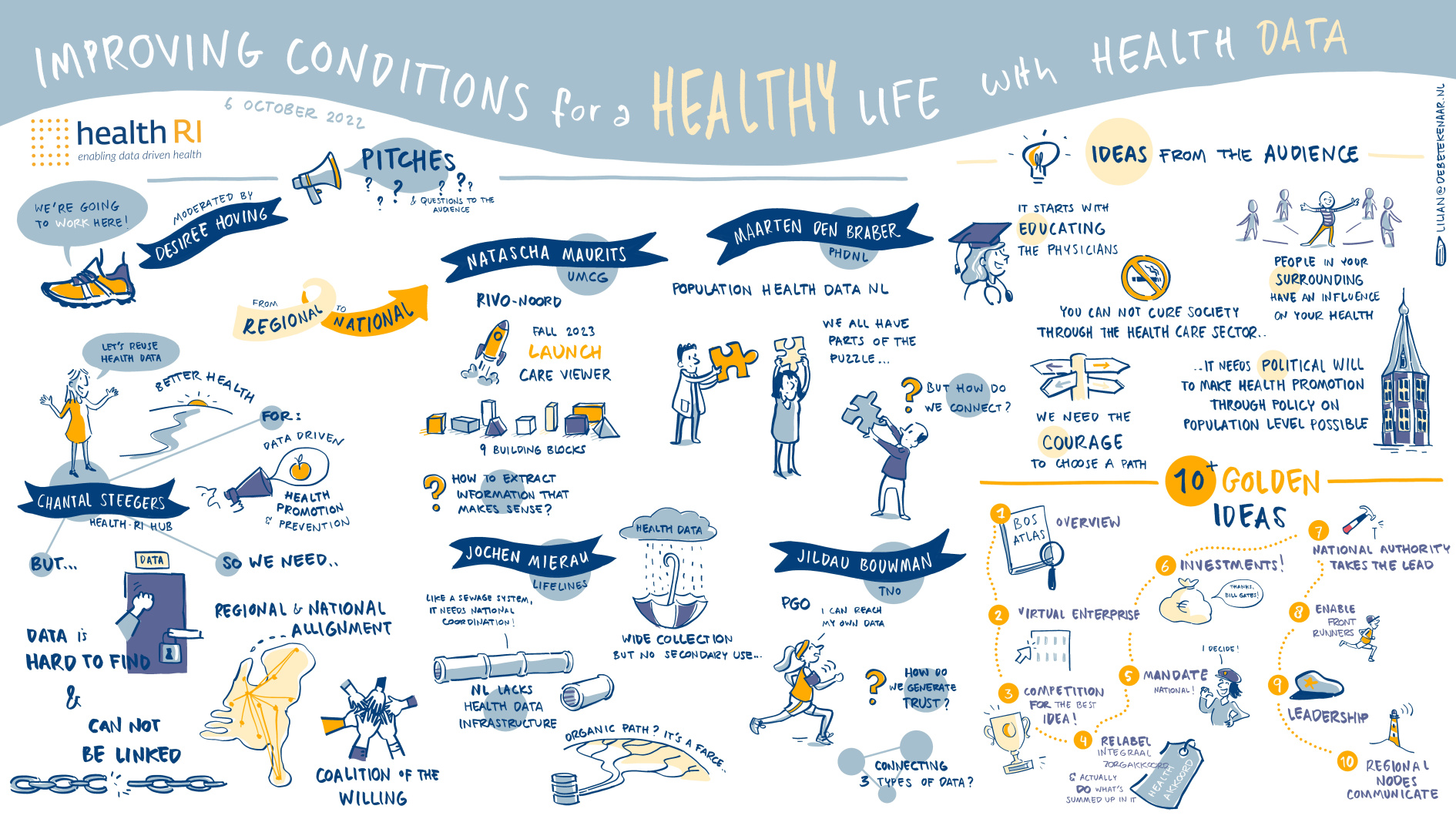
“You have to knock on many doors to get data” according to Chantal Steegers (Health-RI), indicating that collected data is difficult to find. Finding data, accessing data and combining data is challenging, partly due to legal obstacles and due to the lack of a unique pairing key and the use of different standards. These obstacles require a solution. How can we make the connection between health data and facilitate reuse, with the aim to improve the health of citizens and patients?
According to Health-RI, this goal can be achieved through an integrated health data infrastructure at both national and regional levels. During the parallel session Improving conditions for a healthy life with health data – from regional initiatives to a national learning curve, the audience formulated 10 golden ideas to achieve this integrated health data infrastructure.
“Think and act big”
First, the members of the panel introduce themselves with a short pitch. Natasha Maurits (UMC Groningen) is the first one to take the floor, introducing an initiative to realize the connection of health data: the RIVO (Regional Information Provision Consultation Northern Netherlands), that already exists in the northern provinces of the Netherlands.
The RIVO project has come up with a prototype for the ‘care viewer’, using ideas from a hackathon that was organised earlier. In the care viewer, all client or patient data from different care organizations can be seen on one screen. With permission, healthcare professionals can copy this data into the information system used by their organization. The aim of this system is to always have an up-to-date overall picture of the patient as well as connecting the worlds of healthcare and research. The goal is to have the first implementation of the ‘care viewer’ by the fall of 2023, says Natasha Maurits.
Jochem Mierau (scientific director Lifelines Institute) is also in favour of such an infrastructure at national level. The Netherlands is, as he calls it, 'world champion in collecting data'. According to Mierau, the idea that regional initiatives 'organically' grow into national solutions is an illusion. Therefore, there is a need for coordination at national level. “Only then can we think and act big.”
No more 'every man for himself'-mentality
Maarten den Braber (Population Health Data Netherlands) agrees and adds to this that the approach of the regional initiatives is mainly dominated by the here and now. There is a kind of ‘every man for himself’-mentality: each region is doing everything it can to achieve health in its own region. He also points out that there are simple solutions for many problems and that thinking 'too difficult' may hinder innovation.
Jildau Bouwman (TNO) emphasizes the value of different types of health data. She shifts the focus to a more preventive approach. “There is so much information available. Just think about all the information Google and Facebook have from us. Even our voice can tell us something about our health.” With this individual health data from apps, wearables and new software applications, it is possible to intervene earlier and prevent diseases.
The regional initiatives show that patients are willing to share their health data for research, because they feel it might benefit them in some way. Healthy people are a bit more reserved about sharing their data. Therefore, she says, we need to inform patient and the public about the necessity, benefit, and security of sharing this information. Educating citizens, patients and healthcare professionals is the only way for us to get support.
10 golden ideas
After the pitches from the panel there’s room for discussion. The public eventually comes up with ideas to realize a national health data infrastructure. The result of the lively discussion:
1. Create a national atlas of health data initiatives: “create an overview of what is already happening regionally and nationally to avoid overlap.”
2. Create a virtual enterprise in which data can be collected and shared. This works both centralized and decentralized.
3. Organize a competition for the best idea and have representatives from the regions participate. The Ministry of Health, Welfare and Sport gives the party with the winning idea a mandate to implement that idea.
4. Broaden the Integraal Zorgakkoord (IZA) and call it the Integrated Health Agreement from now on.
5. Instruct a national authority to organize a national health data infrastructure. This authority needs to be separate from the Ministry of Health, Welfare and Sport.
6. Let the national government take the lead in the field of information exchange and standardisation, with the Ministry of Health, Welfare and Sport as the frontrunner.
7. Less money should go to regional organizations and more money should go to a national organization that has the mandate to implement ideas and architecture. In this way, we can avoid having the same discussion multiple times and in different places.
8. Support and inform healthcare workers about the importance of a national health data infrastructure.
9. Someone must take the lead. We need to establish in which direction we are going. Hence, we need a ‘national health data highway’ so that we all move in this direction.
10. Communicate information from the regions to the contact persons at the nodes. They can make decisions together with the regions. Those decisions must then be worked out at regional level.
Leone Flikweert (CEO Health-RI) sees in these inspiring ideas and the discussion that there is a great need for a national data authority with mandate. The fragmented landscape in the Netherlands, with its many (regional) initiatives, needs to evolve into an integrated health data infrastructure for research and innovation. Exactly what Health-RI and its partners are aiming for.