

Expertise
FAIR Data
The ultimate goal of FAIR (Findable – Accessible – Interoperable - Reusable) data is to optimise the reuse of data. To achieve this, metadata and data should be well-described so that they can be replicated and combined in different settings.
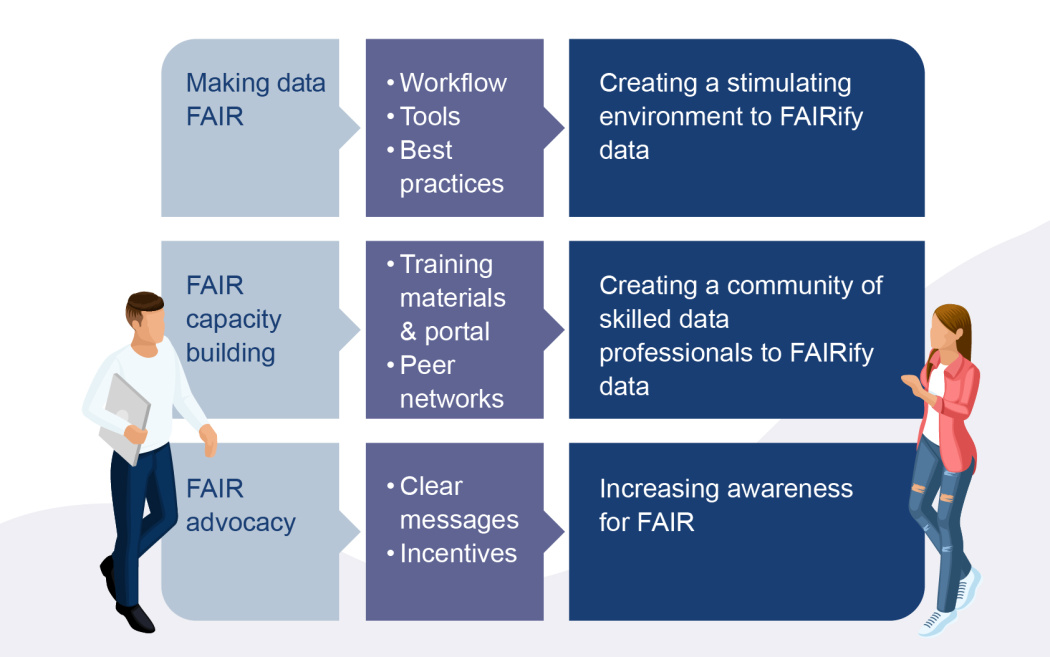
As FAIR data is pivotal in the National Health Data infrastructure, various teams and working groups at Health-RI work closely together with the FAIR coordinators, experts and professionals from the regional nodes on making data FAIR.
This process is coordinated by the Data team at the Hub, in joint activity with the FAIR working group and the Biobanks & Collections team.
What are the FAIR Data principles
Our work is guided by the internationally embraced FAIR principles. They help making data:
- Findable – Enabling users to know if the data they need exists already or whether they need to collect it. The first step in (re)using data is to find them.
- Accessible – Allowing people to know whether they can get hold of data to use for the things they want to. Once the user finds the required data, he needs to know how the data can be accessed.
- Interoperable – Making it easy for people to bring data together with other data to gain insights. The data need to interoperate with applications or workflows for analysis, storage, and processing.
- Reusable – Helping people know what they can and cannot do with data through rich metadata, a clear license and/or terms of use. To optimise the reuse of data, data should be well-described so that they can be replicated and/or combined in different settings.
Benefits of FAIR
There are a lot of benefits from implementing the FAIR principles:
- Avoid duplication of effort and gain maximum potential from data assets
- Reuse data for new purposes and enable new research questions to be answered
- Use new innovative research approaches and tools
- Achieve maximum impact from research
- Enable others to verify your work, increasing public trust in research
Some consequences of not implementing the FAIR principles can be data loss, loss of overview of research, delay of research, lack of reproducibility, reputation damage, losing or having to refund a research grant. We take into account that FAIR data does not always mean open data (e.g., sensitive data), nor that open data by itself is FAIR.
FAIR related activities
We are currently working on the following FAIR activities:
- Making data findable in the National Health Data Catalogue: The Health-RI Data team coordinates and facilitates the onboarding of metadata to the National Health Data Catalogue, and develops its processes. This includes a clear strategy on what to onboard when.
- FAIR Metroline: The FAIR Metroline is currently being developed and provides detailed and practical guidance for making data FAIR. The steps are written by experts in the appropriate fields from Health-RI and the regional nodes.
- Training and capacity building: Building FAIR expertise among data professionals, for instance via the FAIR Data Stewards Basic Course. Community building is an important element, such as the Health-RI Data Stewardship Community and the national Data Stewards Interest Group.
- FAIR requirements from funders: We collaborate closely with funders and researchers to help meet the FAIR requirements set by funders.
- FAIR demonstrators: Projects that have implemented FAIR principles successfully are showcased in the Demonstrator portfolio. The experts involved are presented in the Data Champions portfolio.
- Regular newsletters: We share news and progress updates in the FAIR newsletter, which is sent monthly to FAIR coordinators and others interested.
People involved
Health-RI FAIR coordinators at regional nodes
| Node | FAIR Coordinators | Data management helpdesk / Website |
| Groningen Node (UMC Groningen) | Efi Gkoumasi Morris Swertz Joeri vd Velde Brenda Hijmans | Research Support (umcgresearch.org) |
| Amsterdam Node (Amsterdam UMC) | Rudy Scholte | rdm@amsterdamumc.nl / Research data management Amsterdam UMC |
| Rotterdam Node (Erasmus MC) | Elise Krabbendam | rdmsupport@erasmusmc.nl / Research Support Portal - Erasmus MC |
| Utrecht Node (UMC Utrecht) | Jutta de Jong | datamanagementUMCU@umcutrecht.nl |
| Limburg Node (Maastricht UMC) | Olav Palmen | Health-RI Limburg |
| Leiden Node (Leids UMC) | Anna Niehues Cesar Bernabé | rsd@lumc.nl / research support desk |
| Nijmegen Node (Radboud UMC) | Mirjam Brullemans-Spansier | datastewardship.im@radboudumc.nl / data stewardship |
| Eindhoven Node (Technische Universiteit Eindhoven) | Liz Guzman Ramirez Jay Nair |
Team
Health-RI Hub



Let's engage!
Are you a data professional, researcher or clinician in the health domain? Join us and get in touch with us via Mijke Jetten (mijke.jetten@health-ri.nl).