Home
Break-outsessies Health-RI conferentie 2026
Read the reports on the break-out sessions of the Health-RI Conference ‘Turning Data into Action’, held on 29 October 2026 at the Jaarbeurs.
-
Architecture into Action: initiatives by healthcare institutions to prepare their infrastructure for secondary reuse
In this session, led by Wouter van den Hoeven (Health-RI), Niels Bolding (Health-RI), Simone Louisse (de Nederlandse GGZ), Martin den Heijer (Amsterdam UMC) and Rob Cornelisse (Erasmus MC) discussed how healthcare institutions can connect to the national data infrastructure for secondary use of health data. The central question was how organisations can prepare their infrastructure for sharing and reusing data, and what role the data station plays in this.
The speakers emphasised that the national target architecture is not a stand-alone initiative, but part of a broader ecosystem. Not only technology is important, but also collaboration, governance and the involvement of data holders. The ultimate goal is a scalable infrastructure that aligns with developments such as the European Health Data Space (EHDS).
During the discussion, practical challenges were addressed, such as standardisation, support for smaller organisations and the question of how data holders can be motivated to participate in collaborations.
“Let's not turn this into an architecture party. Let's look at what we already have and how we can use it.” — Niels Bolding, Health-RI
The main conclusion was that a successful data infrastructure requires more than technology alone. Clear agreements on harmonisation and governance, and collaboration between organisations are just as important. The data station, currently under development at Amsterdam UMC (HDSA) and Erasmus MC (HRDS), can serve as an important building block in making health data available on a larger scale for research and innovation by also offering this service to smaller parties within the region. By making concrete applications and practical examples visible, it also becomes clearer what secondary use of data can offer organisations. This can help involve more data holders and encourage them to take steps themselves.
-
Building Data Stewards’ Expertise: Connecting Training and Practice to Drive Data into Action
How do we strengthen the expertise of data stewards and ensure that their knowledge is put to use on a structural basis? During this English-language break-out session, participants joined Rudy Scholte (Amsterdam UMC), Ellen Carbo (ZonMw) and Viola Woeckel (BeterKeten) in a discussion about the professionalisation of data stewardship and the role of data stewards in responsibly making research data available.
Data stewards form an essential link between researchers, data holders and infrastructure. They provide the expertise needed to ensure data quality and FAIR data management, so that research data become findable, accessible, interoperable and reusable. During the session, various initiatives that strengthen this expertise were discussed, including RDNL's training programmes and competency framework, the TDCC-LSH fellowship programme and Health-RI's courses for early-career data stewards.
The speakers demonstrated how data stewardship is organised within their own organisations. Amsterdam UMC works with central and embedded data stewards who support researchers with data management. BeterKeten demonstrates how a data steward can connect different hospitals within a region. As Viola Woeckel put it: ‘A data steward is an essential linking pin – not only within the hospital itself, but also in the region’. Ellen Carbo (ZonMw) emphasised the role of research funders in promoting responsible data management and the reuse of research data. In doing so, she raised the crucial question: ‘How to make change happen?’
During interactive group discussions, participants shared experiences from their own organisations and discussed possible solutions to further strengthen data stewardship. Structural funding, clear job profiles, a formal mandate and greater recognition of the profession were identified as key areas of focus. The possibility of registration or accreditation of data stewards was also discussed. Participants emphasised that data stewardship is a shared responsibility of data stewards, researchers, administrators and research funders. A recurring point of discussion was how organisations can go beyond the requirement to draw up a data management plan. Participants noted that DMPs are not always actively used or updated in practice. The extent to which research funders can verify whether agreed arrangements are actually being followed was also discussed. After all, the ultimate goal is not a completed document, but high-quality, findable and reusable research data.
The discussions yielded various perspectives and concrete suggestions. The main conclusion was that data stewardship needs to be more firmly embedded in organisational strategies. In addition, a call was made to strengthen collaboration between support functions and give greater visibility to successful examples from practice. Researchers who act as ambassadors for good data management and FAIR data play a leading role in this. In this way, the available expertise can be further developed and more widely used.
-
AI and secondary use of data: the value and challenges
What opportunities does AI offer to improve healthcare, and what is needed to actually seize these opportunities? During this break-out session, Franka Boender (Ministry of Economic Affairs) presented the MedTech 2035 policy agenda, in which she emphasised the importance of MedTech and AI for future-proof healthcare. The initial focus is on image-guided therapies and the hospital of the future. Jildau Bouwman (TNO/Leiden University), Edith van de Weg (AI Fabriek), Mirjam Plantinga (UMCG) and Daan Geijs (Kaiko) then discussed the opportunities and challenges of AI in the secondary use of health data, in a discussion led by Maartje Muskens (Health-RI).
The opportunities are considerable. AI can contribute to better prevention, personalised treatments and keeping healthcare accessible. However, according to the panellists, the greatest challenge lies not so much in the technology itself, but in the availability of high-quality data and the implementation of applications in everyday healthcare practice.
The panellists emphasised that many initiatives remain stuck in the pilot phase. Fragmented IT systems, differing agreements and lengthy application processes make it difficult to deploy successful applications on a larger scale. Investment is therefore needed to improve the existing infrastructure and establish shared agreements on data exchange.
Data quality and representativeness were also discussed extensively. AI applications can only produce reliable results when the underlying data are suitable for their intended purpose and accurately reflect society and patient groups. Legal, ethical and organisational issues must be taken into account from the outset.
To stimulate the development and implementation of AI and MedTech, participants discussed the need for guidelines on transparency in data use by companies and the reproduction of developed AI models by healthcare organisations.
During the lively discussions, it became clear that collaboration between hospitals, researchers, companies and governments is essential. The call to the field was to better connect existing initiatives, learn from regional experiences and develop shared agreements.
The main conclusion: to fully realise the enormous potential of AI to improve healthcare and reduce health inequalities, we need reliable and accessible data, national coordination and greater attention to the implementation and scaling up of effective applications.
-
How do we enable responsible use of data by companies?
How do we ensure that the reuse of health data by companies generates as much societal value as possible? During this break-out session, participants explored how innovation, trust and reciprocity are interconnected. Fien Vleminckx and Miriam Beusink provided an introduction to the topic, after which a panel featuring Joep Rijnierse from the Industry Advisory Committee and Cecile Spiertz from the Societal Advisory Council engaged in a discussion with the audience.
Companies play various roles in the health data ecosystem: as suppliers, data holders and data users. They use health data for, among other things, scientific research, product evaluation, feasibility studies and the development and validation of AI applications. The ultimate goal is not data availability in itself, but better healthcare for patients.
Miriam Beusink presented insights from previous discussions with patients and companies. Three key themes emerged: societal value creation (companies may make a good profit, provided that data reuse genuinely benefits citizens and patients), trust (for which greater transparency is essential), and the distribution of responsibilities and influence. Clear safeguards, oversight and information about who reuses data, for what purpose and with what results are essential to strengthening trust in the use of data by companies.
During the interactive discussion, there was broad agreement that companies play an indispensable role in healthcare. Opinions were more divided on other topics. For example, discussions arose about whether commercial and non-commercial parties should be assessed in the same way and whether different fees for data access are justified. Participants also discussed who should inform citizens about the reuse of health data.
An important insight was that the EHDS does not eliminate the need for collaboration between companies, researchers and healthcare institutions. Close collaboration remains essential to properly understand and responsibly use data.
The session made clear that socially responsible data use requires a careful balance between reducing risks and increasing societal value. This requires clear rules, transparency towards citizens and close collaboration between public and private parties. Ultimately, this collaboration must lead to innovations that genuinely benefit patients.
-
Making real-world health data available for secondary use: getting data moving
How can healthcare institutions make their electronic health record (EHR) data available for research, policy and innovation? During this break-out session, Jos Hendrikx (Nictiz) and René Oostergo (UMCG), under the guidance of Janet Vos (Health-RI), explored the steps that data holders can already take to make their EHR data findable and accessible for secondary use.
Janet Vos introduced a maturity model for making EHR data available. The first step is to make data findable in the national health data catalogue. Data holders can describe their EHR data in a single metadata record, so that data users know which organisations they can approach. The next step is to explore which patients and data are actually available at a data holder. Making unstructured data available, such as free-text fields in the EHR, presents an additional challenge.
Jos Hendrikx explained how developments in data exchange for everyday healthcare also offer opportunities for secondary use. Nictiz is working on generic building blocks as a further development of the existing clinical information building blocks. This contributes to a more shared information base for healthcare and research. At the same time, questions remain regarding data quality, usability and alignment between different information models.
René Oostergo then demonstrated how UMCG has already made its EHR data findable in the national health data catalogue. Using a practical example involving patients with Crohn's disease, he demonstrated how Epic's SlicerDicer could be used to answer an exploratory question within a single day. A total of 215 patients were identified who met the specified criteria. He also showed how UMCG registers data requests and records the use of patient data.
During the interactive discussion, it became clear that there is still a gap between the data researchers need and what data holders can easily provide. Participants identified contextual information, patient-reported outcome measures (PROMs) and lifestyle data as important additions. The completeness of EHR data was also discussed. After all, data on diagnoses and treatments may be spread across different hospitals. As René Oostergo emphasised: “You don't necessarily get the whole truth, you get the truth according to the system.”
Finally, participants discussed whether shared standards are necessary to make EHR data available within three months. A majority agreed, while others emphasised that the usability of data and practical feasibility are particularly important.
The session ended with a concrete call to data holders to take the first step now: describe their EHR data in a metadata record for the national health data catalogue. Guidelines are available for this, and organisations can receive support from Health-RI's onboarding team.
-
Contribute to the data journey: describing, onboarding, searching, requesting and using data
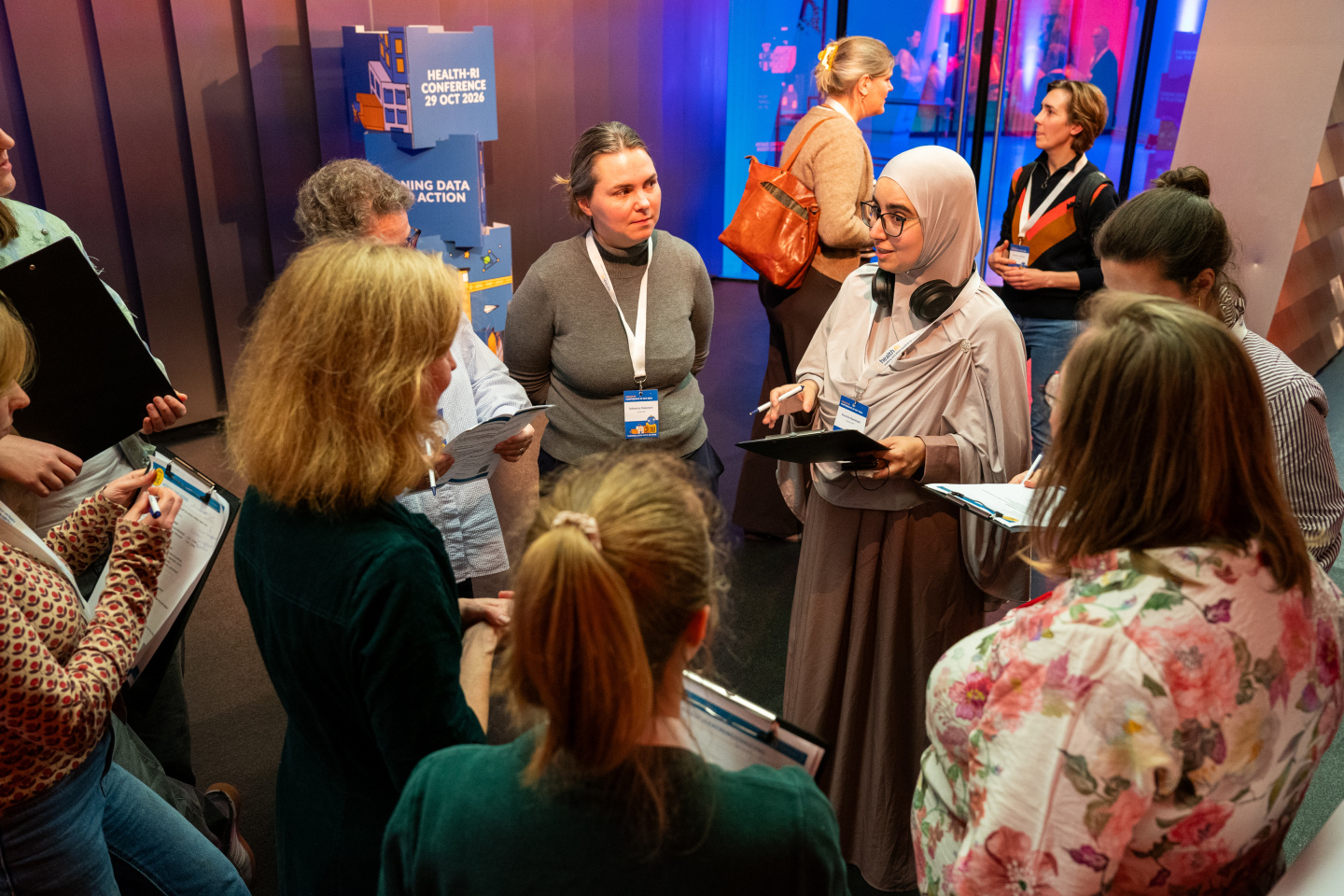
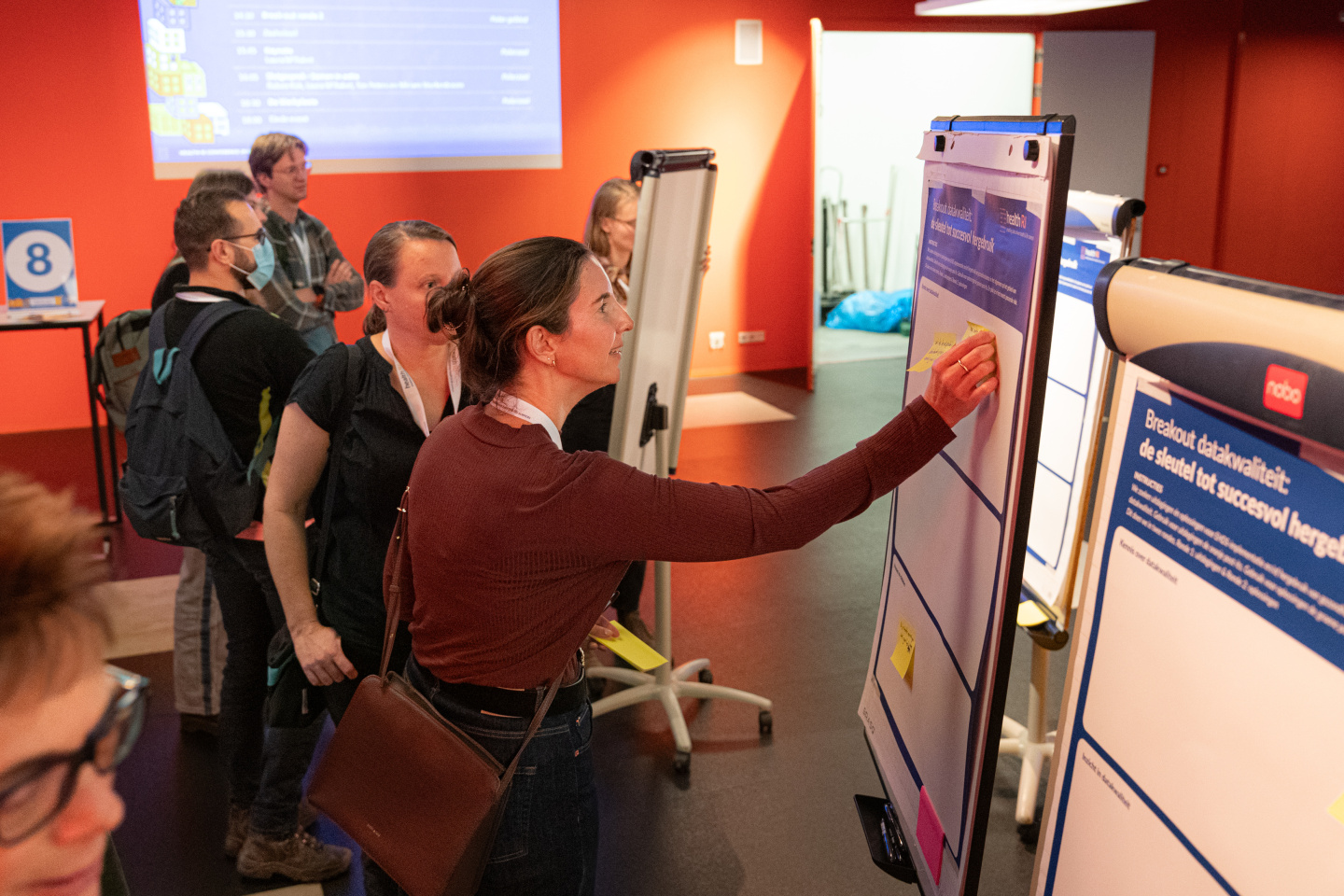
How does the national health data infrastructure work in practice? During this interactive break-out session, participants could go through the various steps of the Data Journey themselves. At separate stations, they were introduced to onboarding metadata into the national health data catalogue, searching for and requesting data, making data available by data holders and analysing data in a secure processing environment. At each station, participants could ask questions of experts from Health-RI as well as data holders with experience of the national health data infrastructure, exchange experiences and explore the opportunities and challenges within the different parts of the chain.
A recurring question was how organisations can start taking concrete steps to prepare for the European Health Data Space (EHDS). Reference was made to the six-point action plan developed by Health-RI and the Ministry of Health, Welfare and Sport (VWS), which outlines practical steps that data holders can already take. Participants also wanted to know when an organisation is considered a data holder and which data fall within the scope of the EHDS. It became clear that this concerns not only hospitals and EHR data, but a much broader range of organisations and data categories, as described in Article 51 of the EHDS.
At the station focusing on metadata and the national health data catalogue, several practical points were raised. Some participants found the amount of information in the catalogue overwhelming and wondered where to start when searching for suitable datasets. Representatives from universities also indicated that researchers were not yet sufficiently aware of the catalogue. Participants therefore saw opportunities to raise awareness of the catalogue within university education programmes and asked Health-RI for supporting information packages.
There were also questions about the metadata schema and how to describe specific datasets, such as data collected through questionnaires. Participants also asked about IKNL's experiences with making datasets available and findable.
The session made clear that a functioning infrastructure alone is not enough. To fully realise the potential of secondary use of data, organisations and researchers must also know how to find and use the various services. Clear explanations, practical examples and support in taking the first steps are therefore of great importance.
At the station focusing on data requests, it became clear that many participants did not know where external requests were received within their own organisations and acknowledged that this would need to change under the EHDS to avoid consequences. Visitors were interested in learning about a possible solution through practical examples shared by Charlotte (LUMC), illustrating how a Single Point of Contact (SPoC)/central data access desk can act as a central coordinating hub. Many questions were raised about how smaller data-holding organisations would manage this, particularly in terms of capacity and data expertise. Could an organisation take on the role of a regional SPoC now, or a Health Data Intermediary Entity under the EHDS?
At the station focusing on SPEs, visitors were particularly interested in how the Health-RI MyDRE SPE works and the possibilities it offers researchers. Visitors also learned how data are made available in an SPE in the Amsterdam and Rotterdam regions. The delivery of data by data holders via a data exchange platform and MyDRE's Data Drop Zone were discussed, as were developments towards EHDS-compliant SPEs. Visitors expressed concerns about the possibilities of keeping data available after research had been completed and the capacity of smaller data holders to provide their own SPE. The possibility for smaller data holders to make data available through the Health-RI SPE was also discussed.
At the station focusing on metadata submission, concerns were raised about the capacity, expertise and time required to submit metadata, particularly for smaller data holders who are not yet well informed. They expressed interest in the manual submission method currently being developed as a service by Health-RI.
-
Building trust in data through data quality: the key to successful reuse
How do you know whether health data are of sufficient quality to be used for research, policy and innovation? During this break-out session, Ellen Leenarts (RIVM) and Joppe Tra (Health-RI) explored the role of data quality within the European Health Data Space (EHDS) and the development of the QUANTUM Data Quality & Utility Label. This quality label is intended to help data holders and data users gain better insight into the quality and usability of datasets.
The speakers explained the obligations that the EHDS introduces for data holders, including publishing metadata, making data available upon request and providing information on data quality. The QUANTUM framework offers a method based on twelve dimensions of data quality and utility. Data holders provide this information themselves, based on which a quality label is generated. The first labels have now been developed and tested. Training materials are also available, and work is underway to incorporate the labels into the national health data catalogue.
During the discussion, questions mainly focused on practical feasibility. How much time does it take to complete a quality label? At what level of detail should quality be described? And how can we ensure that the information provided by data holders remains reliable and up to date? Participants pointed to challenges such as limited capacity and expertise, fragmented knowledge and the lack of priority given to data quality within organisations.
An important insight was that data quality always depends on the intended use. A dataset that is suitable for one research question may not be suitable for another. As the quality label is completed by the data holder, while its actual usability is assessed by the data user, coordination between the two remains necessary. The value of the label therefore lies not only in the assessment itself, but above all in the underlying information about the quality of the data.
Participants discussed various ways to support the use of quality labels, such as joint training sessions, better data recording at the source, more centralised knowledge sharing and additional funding for data holders. It was also suggested that data users could play a role in assessing datasets and providing feedback on their experiences.
The main conclusion was that quality labels can contribute to greater transparency and responsible reuse of health data, but that their implementation requires more than just a technical solution. Sufficient knowledge and capacity, adequate support and continued collaboration between data holders and data users are essential to effectively improve data quality.
-
Triple A: Architecture, Alignment and Agreements – connecting primary and secondary use within a single framework of agreements
How do we ensure that the infrastructure for primary and secondary use of health data is aligned? What technical agreements are needed, and how should governance be organised? During this break-out session, Ruud Bongers (VWS), Jeroen Beliën and Simone Salemink (Health-RI) explored the relationship between architecture, alignment and national agreements.
Ruud Bongers explained how the Architecture for the Health Information System (GISA) provides direction for the development of the Dutch health data ecosystem. The EHDS sets European requirements, but many aspects and infrastructure components need to be organised at national level. Jeroen Beliën demonstrated how Health-RI's target architecture for secondary use aligns with the target architecture for primary use and the generic functions, and fits within GISA. This architectural alignment provides direction for the development of a shared infrastructure for multiple uses of health data.
However, alignment on architecture alone is not sufficient. Simone Salemink also emphasised the importance of agreements through a national framework of agreements (LAS), in which organisations establish shared agreements on aspects such as technology, interoperability and governance. The existing Twiin framework of agreements has been designated by the Ministry of Health, Welfare and Sport (VWS) as the basis for this. In a few years, all national agreements on multiple uses of health data will be incorporated into this framework. The Health-RI Framework of Agreements currently serves as the place for national agreements on secondary use, which will gradually be incorporated into the national framework of agreements. Over time, all sets of agreements, together with GISA, will contribute to the development of a single, coherent and more binding national framework of agreements for the entire health information system.
During the interactive part of the session, participants discussed which topics related to secondary use should be prioritised for national agreements. Topics included governance, the choice of metadata model, standards, data quality requirements, secure processing environments and citizens' control over their data. Governance and metadata description, in particular, were identified as priorities for 2027.
Several participants wanted to know how their organisations could align with GISA, the LAS and the Health-RI Framework of Agreements for secondary use. There was a clear need for further explanation of how these relate to one another and how other existing initiatives should align with them.
The main conclusion: national agreements are necessary to ensure that the various components of the infrastructure actually work together. This requires not only technical standardisation, but also clear agreements on roles and responsibilities and the active involvement of organisations across the field.
“We want to move from ‘comply or explain’ to ‘comply or die’: if you want to participate, you must demonstrate that you can comply with the agreements; if you do not, you cannot participate.” – Jeroen Beliën
-
The Value of European Data
What is the value of European health data for research and innovation, and how can we make better use of it to improve the health of European citizens? During this English-language break-out session, participants engaged in a discussion with each other and the audience about the opportunities and challenges of data use within Europe.
An important theme was the need to move beyond treatment based on population averages. According to several speakers, health characteristics vary considerably between countries and population groups, making European datasets necessary to better tailor healthcare to individual patients. It was emphasised that not only patient data, but also data from healthy citizens are of great value, particularly for prevention and understanding health risks.
Citizens' trust and control over their health data were also discussed. How do we ensure that people understand what their data can be used for, so that they can make a well-informed decision about whether or not to make it available? The panellists discussed the advantages and disadvantages of opt-in and opt-out systems and the importance of providing clear information to the public.
A concrete example of the importance of European data came from research into intensive care unit (ICU) populations. A predictive algorithm developed using American patient data proved unsuitable for the Dutch ICU population, as these patient populations differ considerably. This underlined the need for representative European datasets to develop reliable applications for Europe's own population.
In the discussion about Europe's international position, it was concluded that Europe's strength lies in collaboration, stable investment and high-quality infrastructures such as biobanks and cohort studies. At the same time, it was noted that sustainable funding and better coordination are needed to prevent fragmentation of initiatives.
The main call was to better connect existing European initiatives and translate the opportunities offered by the European Health Data Space (EHDS) into practice. According to the panellists, joint practical examples covering the entire journey from data request to use can help identify bottlenecks. They called for closer collaboration between researchers, healthcare institutions and companies, as well as long-term funding for the necessary infrastructure. In this way, Europe can truly harness the diversity of its health data for better prevention, research and healthcare.